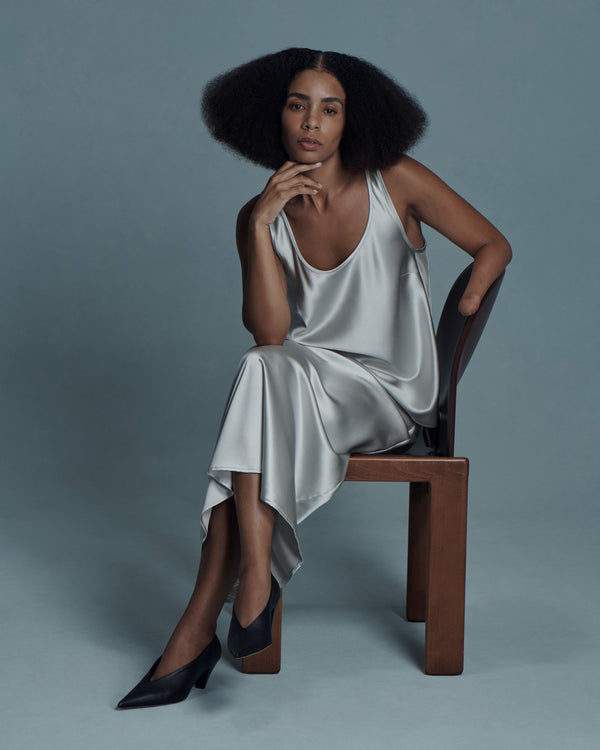


Jesi was twenty-three, working at a very bougie French café, when she decided to leave her makeup at home.
That may sound like a small decision, but it was not. She has vitiligo, and makeup had never been for fun. It was about coverage: applied every day, as part of a wardrobe built entirely around not being looked at.
"I was told what to wear for a very long time. Because of my skin disorder, there was a while where I was mostly just dressing to cover and hide."
Nothing specific prompted the change. No incident, no conversation, no slow dawning.
Just a moment of: "I just can't do this anymore. And then I just did that. I'm kind of impulsive," she said almost matter-of-factly.
Some years and one cane later, she describes her personal style in two and a half words: edgy Pippi Longstocking. What replaced hiding wasn't confidence, exactly, but a rule she invented for herself: a garment has to bring her sensory joy. Not conceal anything, not flatter anything. Just feel good for the entire day she has to wear it.
Everything she wants from clothing follows from that.
First, the rule.
"Not only am I not going to [cover myself up] anymore, I'm also just going to wear what brings me sensory joy. Since I've started dressing for sensory joy and comfort, [I’ve] embraced how fun getting dressed can be."
It's an extremely useful idea: a criterion for getting dressed that has nothing to do with how a garment looks on you or what it covers up. In practice, it produces one silhouette, in many colors.
"Just an easy pull-on maxi dress. That's my go-to. I've got a lot of maxi dresses in different colors, just because it's bada-bing-bada-boom. It's just so easy."
She slips things on. She doesn't pull things over her head. And because she doesn't do much with her hair or her face, the dress is carrying the entire look.
"It's nice when I can have a bold maxi dress that's got a vibrant color or cool texture. I like to mix patterns. That's my ideal."
Which is where Pippi comes in.
"A mix of colors, textures and patterns that people at first glance might think doesn't work, but because I'm so sure of myself, it works."
The makeup, meanwhile, is still around. It’s job description just changed.
"I used to wear makeup for cover. Now when I do, I'm just having fun with it."
And the reasoning underneath it is more clear-eyed than confidence.
"I don't necessarily want to be seen. I just don't really care as much if I am anymore. And if people are going to stare anyway, I might as well wear whatever I want."
She arrived to set with a critique of the category already formed.
"Not only are there not [many] adaptive brands out there, but when they are — and let me word this very carefully — they're functionally great, and it's a shame that there really isn't more of a range of style options. What I love [about WELDUN] is that you have a brand that's creating for that adaptive function while also making aesthetic choices that are really good."
She has used a cane for three and a half years. Loving it took longer than needing it.
"I didn't always love it, and I didn't always use it."
The obstacle was never the cane. It was everything around the cane.
"There's a lot of ableism, even casual ableism amongst friends and family. And a lot of it was internalized ableism too, where I was like, I'm not even actually that disabled. Why would I start using one?"
What broke the deadlock was a reframe about capability rather than limitation.
"Until it got to the point where it's like: oh, I can actually do the things I want to do if I have help. I need the support. There are things I need, and it's okay to need support. Accepting this doesn't mean anything bad or negative, or anything I should be embarrassed about. I need support, and this helps me get around. And it helps that it's cute."
She owns only one, but has plans for the next.
"A plain white cane, and then letting my daughter paint it."
The idea she keeps returning to is that the problem was never located in her.
"Something that's really helped me is keeping in mind that my struggles are not the problem, it's structural systemic issues that are the problem."
She isn't minimizing the daily reality of it. She's precise that both things are true at once: the difficulty is real, and the difficulty is manufactured.
"When you lack access to infrastructure where you live, or resources in your personal life to be able to navigate life in a way that you need to, it's important to keep that in mind. Try not to make this about the ways that you are somehow less than, or a problem. There are structural reasons why you are struggling right now."
Her seven-year-old, without being taught to, has arrived at the same conclusion by a shorter route. When people ask about the cane, she has an answer ready.
"My mom just needs it to help her walk."
Her advice to anyone earlier in this journey than she is:
"You're only going to have your body how it is right now. You don't know what you're going to be able to wear, how you're going to be able to carry and present yourself, even a month from now. So if you can put on the bold thing, wear the quirky outfit, mix the patterns you think look and feel cool — then do it. Now.”


