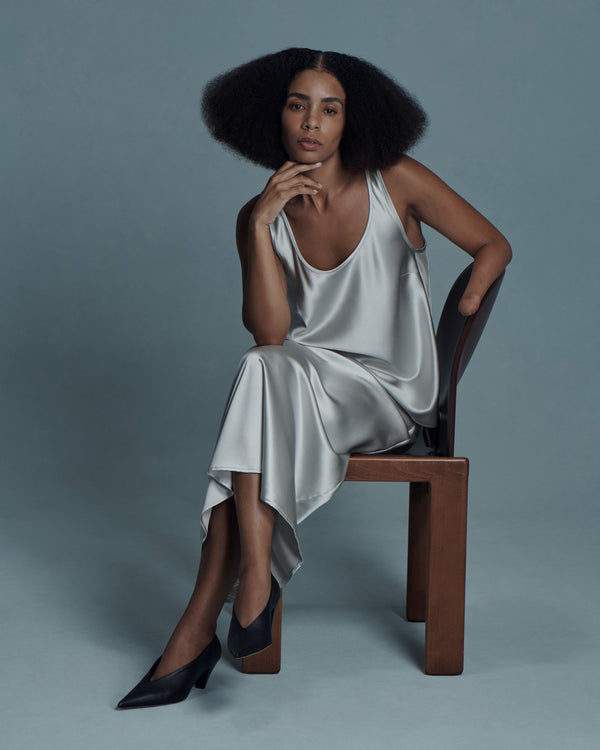


The first sign was a shirt button.
"Now that I'm getting older, I feel like my fingers don't work the same way. Sometimes I'm going, why can't I button this? Why am I struggling?"
The longer answer starts in East Germany. As a small child, Sylke was in an accident that left her right hand badly reset. She was seven, in first grade, and right-handed. She had to learn to be left-handed instead.
"I went through several surgeries. When they removed the cast, I didn't have any feeling. I thought I might never get the feeling back, plus I had really limited mobility. I had several operations throughout the years, and finally, it is what it is."
So one hand did the work. For fifty years. Now it's aging the way any hand ages, and the other still hasn't come back.
"Really, my left hand has done all the work. My left hand is overworked, and my right hand has mobility issues. So you find ways around it."
The evidence turns up in a kitchen more often than a doctor's office.
"When you get older, you see for the first time — they can no longer open cans. Like, oh man, this is happening to me. I can't get the packaging off."
She has spent those same decades being professionally dressed by other people, which has left her with exact ideas about what a garment owes her.
What she wants from a garment is a narrow target, and she is exact about it.
"It doesn't matter really what I wear in my house. But when I come to a studio, to a set, I want to feel dressed up. I want to look a little polished, a little bit put together."
And it has to be easy. Her standard is a piece with the softness of sweatpants that, under no circumstances, reads as sweatpants.
"It's got to have the softness, being as comfortable as sweatpants, or your favorite shirt. But it still has to have that something where I want to look like I got dressed to go out."
The same logic runs all the way down to her feet.
"I want to wear my nice sandals. They need to be comfortable, but they've got to be beautiful. They've got to stand out a little bit. A little extra."
She learned what that felt like early.
"When I first started modeling, Giorgio Armani was a big job for me, and I fell in love with his suiting. His suiting was always soft, and it always fit really well. Perfectly tailored. Not constricting. You could wear it and not feel dressed up, and not feel really slouchy."
Decades on, that's still the brief.
Her own style she calls tomboyish, and the reasoning is entirely practical.
"I'm not a person to really have a lot of skirts. I occasionally buy a skirt, but I find that I don't wear them. So really, [it’s about] the pant. It's the city we live in, I feel I can move in pants, or in shorts. Sometimes I don't want to be proper."
Nothing about this arrived as a revelation. Asked whether there was a moment her relationship with getting dressed changed, she was almost dismissive of the premise.
"It just happens gradually. You realize what you gravitate to. And the comfortability of knowing yourself."
That's the phrase, and it's better than anything we could have written for her. What it buys her is speed. She'll still see something beautiful and want it. The difference is how fast the next question arrives.
"You might go for something that's really beautiful, but really, the reality is, how often will you wear this? It will hang in the closet and it's amazing. And there's times for those pieces. But it's got to be multifunctional. You start to learn what pieces work well together, and still be true to what makes you feel you."
Except that what makes you you doesn't hold still, and she knows it — she says so before we can ask.
"What makes you, you — that changes. There was a time when I never used to wear jeans. Never. And now I'm like, I understand. I get it."


