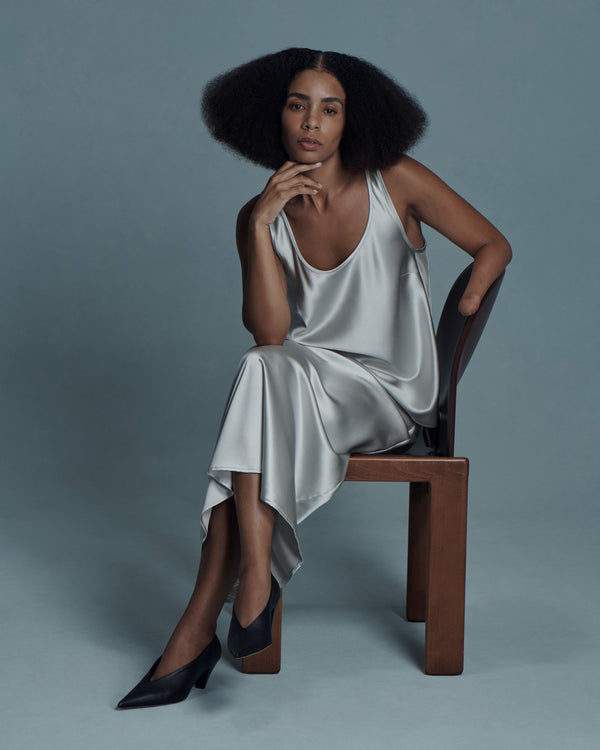


Ash has been a model since she was seventeen. She turned thirty the week after the very first WELDUN shoot. For most of the years in between, she got dressed to be perceived: a client's idea of her, the industry's idea of cool, a version of herself assembled largely from other people's notes.
Now, some mornings, she would like to look like a twelve-year-old on the way to soccer practice.
What changed was ovarian cancer. She's six years out, in remission and fully recovered, and she's precise about the timing: it was after cancer that she started doing what she wanted. She has a scar across her midsection. She hid it at first. She doesn't anymore.
Coming out of it, the first instinct was to hide.
When she started getting dressed again, she avoided anything that showed her midsection, because of the scar. Not for long — but the instinct arrived on its own, and it took a while to leave.
"Now I don't hide it. I don't worry about wearing things that might show it. I wear it with a lot of pride."
Her style runs on contradiction, on purpose.
She likes juxtaposition — her word, and she comes back to it. Something old paired with something new. Something sporty and boyish paired with something girly. And when she isn't doing that, she's doing the opposite: committing entirely to one idea for a day.
Sometimes that means dressing like a little boy, in enormous baggy clothes, looking — in her own words — “like a twelve-year-old on the way to soccer practice.” Sometimes it means a nice dress and a scarf tied in her hair. What she won't do is split the difference.
Her personal style in three-ish words: juxtaposition, all in, freedom.
It hasn't always been like this.
She has modeled since she was seventeen, and this interview took place just before she turned thirty. Thirteen years of being told how to show up — what a client wants, how to be perceived, what reads as cool and acceptable. She spent a long stretch dressing to be seen the way other people had decided she should be seen.
The shift is recent, and she puts it plainly: it was after cancer that she started doing what she wanted.
Asked what one thing a designer could make to change her life, she picked a shoe.
A slip-on. She doesn't love laces — they get dirty, they come undone, they're a small daily negotiation in a city. She wants something she can put on and go that still looks considered rather than sloppy. Timeless, easy, not messy.
The thing she most wants from a fashion brand is not a product.
We asked what she wished the industry had offered her during treatment; whether it was more easy-on options, or something deeper. She went to storytelling, and then past it, to why the storytelling is hard.
Illness gets read as death. As negative, as a subject that makes a room go quiet. People don't know where to put it, so they don't bring it up.
"I have so much love for what happened [to me]. I appreciate it and I'm proud of it, and I want to talk about it."
Ash is careful and at peace when talking about her lived experience. She isn't asking anyone to be comfortable who isn't. Not everyone has the same experience, and she says more than once that this is fine. Her argument is narrower and better than that: if these experiences could be shared normally, people would find out they aren't all negative. That there's love in them, and lightness, and a lot to learn.
And that you don't have to have been through the same thing to meet someone in it.


