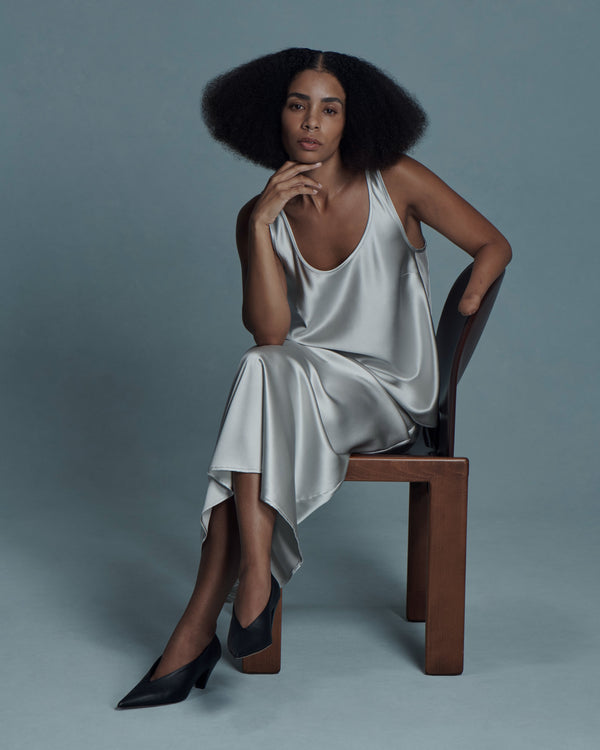


Christina Mallon's bed has four posts, and one of them is how she gets dressed.
She owns a lot of dresses without closures. Three holes: two for the arms and one for the head. She loops the head hole over the post, puts her head through, and dances her arms in, working the fabric down with her core until it sits. "If you were to see it and not know context, you would think I'm doing some type of new Pilates," she says, smiling. "Literally, that's how I get dressed."
Fifteen years ago, newly arrived in New York and living alone on the Upper East Side, Mallon noticed that one of her fingers had lost some of its flexibility. Her doctors guessed she had slept on her hand after a late night at the office. Then it happened to a second finger, and, as she puts it, the math wasn't mathing. For the next several years she traveled the world looking for an answer while both arms lost function. Around year eight, the progression stopped. The closest anyone has come is a rare form of ALS, but no one is certain, because no one has seen many cases like hers.
Not having a name for it turned out to be clarifying. "Because I couldn't really attach myself to a typical diagnosis, I felt as though, why don't I try to help solve problems that are associated with many disabilities?" she says. The biggest of those problems was independence, and the sharpest edge of independence was getting dressed. Closures. Styles changing, seasons changing, a New York winter's worth of layers. She needed help every morning.
Then she met Grace Jun, one of the founders of Open Style Lab, which was doing something genuinely radical at the time: putting engineers, fashion designers, and occupational therapists in a room together and asking them to solve for self-dressing. Mallon was working in advertising, running marketing strategy, and she took the idea to her manager. Why couldn't this apply to the brands they consulted for? She went on to build the first inclusive design practice inside WPP, working with Tommy Hilfiger, Microsoft, and GSK. Microsoft eventually recruited her to lead inclusive design as the company invested in generative AI. She has been there four and a half years, and sits on the board of Open Style Lab.
The through-line from her own bedpost to a Microsoft design review is the same question asked in both places: can a person do this without having to ask for help?
Most people, when they become disabled, orient entirely toward a cure. Mallon went the other direction. "We'll be able to find solutions much quicker for the problems that I run into from a design perspective." The logic is straightforward, unsentimental and hard to argue with. Nobody has cured ALS. Somebody could put elastic in a waistband.
It also reframes what disability is, at least in her own life. "I only feel disabled when I run into these challenges," she says. "By creating solutions for them, I feel so much better."
That framing produced a design constraint she now brings to every designer she works with. She won't accept a solution that depends on equipment. "If I have to use an assistive device, that's too hard. I can't pack that with me. I need to be able to use the physical space around me." So the brief becomes: a doorknob, a bedpost, a lamp on the floor. Anything heavy enough to pull against. Get the garment on using the room, because the room is always there and the device is always at home.
The catch is that very few garments are built to be worn that way, which means the first question Mallon asks about any piece of clothing is not whether she likes it.
"One hundred percent," she says. "Can I get dressed myself, or am I going to have to call down to the hotel lobby to see if there is a woman working the front desk that can help me?" She travels constantly, for Microsoft and for Open Style Lab, and travel narrows the field to whatever works unassisted.
It narrows at the office, too. Mallon sits between the engineering and legal teams at Microsoft, among people who dress the part. "Everyone wears suits, and they really dress. There's so many lawyers, and I can't really put on a blazer myself." The consequence isn't inconvenience, it's standing. "Sometimes it makes me not feel confident when I'm talking to people more senior than I, because I can't dress for how society thinks is appropriate for the venues that I go in."
Ask what she would wear if everything were available to her and the answer is immediate and specific: ex-New Yorker, black and tan and grey, clean, very Italian. Which is precisely the register that tends to refuse her. "Sometimes with some designers that are like that, they won't use elastic," she says. Pleats instead of stretch. Tailoring instead of give. "That frustrates me a lot, because some of the things that I have to wear are not exactly what my personal style is.”
The piece that resolves the tension is an Issey Miyake Pleats Please set, and she will always pack one. It reads chic. It survives a hotel sink if something spills. It has kept fitting through two pregnancies and the body changes that followed. "It allows me to feel confident and to express my personal style while also looking appropriate," she says. The price keeps her from owning many. She is hunting the vintage prints on Poshmark and The RealReal, where they sell out fast.
What she cannot find easily is a suit.
"I have to wear things that are baggy, because it's easy to slip on, and the elastic waist style is usually on a baggy pant," she says. What she wants is a fitted suit with elastic at the waistband and a jacket with some adjustability built in. More broadly: clothing that flexes across a life rather than a size. "Let's say pregnant, not pregnant, in a formal place, but also could dress down. That doesn't really exist."
And pockets. Her arms hang at her sides, which can be painful, and a pocket is somewhere to rest a hand. Most stylish blazers don't have working ones. "It's very strange, and I don't exactly know why, because from a cost perspective with the extra lining, that's not expensive at all to make pockets functional.”
Fifteen years in, the advice she gives to people earlier in their health and recovery journey is not about clothes. It's about saying things out loud sooner. "Everyone has something going on, and most of the time we don't know about it," she says. "Being upfront about what you're going through, even though you feel like you're sharing too much, is not wrong. Nobody's really thinking about you. They don't know what's going on with you."
The people she has told, particularly the ones just outside her close circle, have surprised her. At her daughter's school, when parents are brought in for activities she can't do, she'll ask another mother to keep an eye on her daughter, to help with the crafts, to pack the extra pair of pants. "Those people also feel really special that I chose for them to tell my personal story and ask for their help. So never feel like a burden. People really want to help.”
The last thing she wants understood is aimed at people who assume none of this concerns them.
"All people need to understand that their bodies will change," she says. "No matter how much biohacking we do, we haven't invented cures for everything. Their future self will become disabled, and it's in their control if it's going to be a bad experience or not. Right now, they can invest in adaptive clothing. They can really think about those decisions that they make on a daily basis of how they are thinking about their future self, which might be disabled. A lot of times people never think it's going to happen to them, but it 100% happens to everyone, because we age."
Which is where the clothes come back in, and where Mallon draws the sharpest distinction of the conversation. Dressing well changes how she is read. "The more that they could see themselves in you, and by being fashionable, they look at, oh, that person's similar to me. Or that person, not as inspirational, but aspirational. If we can show disability like that, that really changes things."


